


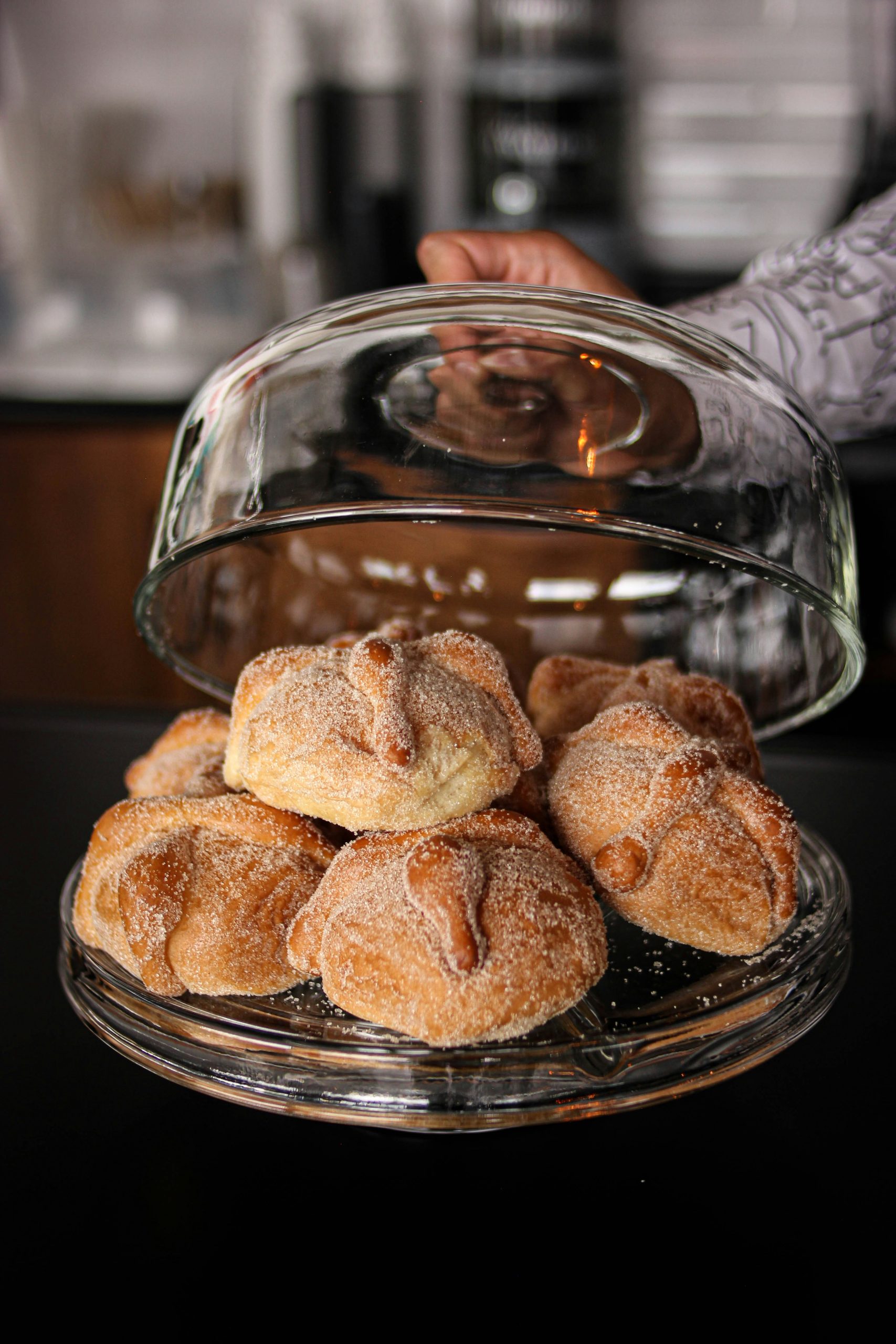
From the land of pyramids, hot salsa, and tacos in every shape and size imaginable comes a sweet bread that’s going to blow your mind, pan dulce, and trust me, you need to try this one this autumn.
First things first: pan dulce (sweet bread) is a massive deal in Mexico. Every neighbourhood panadería (bakery), and honestly most large supermarkets too, is stacked with an incredible range of breads that get eaten daily, usually with a coffee, as a kind of evening ritual. It’s one of those small, quiet moments where families and friends sit down together and chismear (gossip) about, well, everything.
But there’s one pan dulce that beats all the rest — loved by pretty much everyone, and eagerly waited for all year: Pan de Muerto.
Pan de Muerto (“Bread of the Dead”) shows up all over Mexico, and while the exact recipe shifts a bit region to region, shape, colour, flavour, the classic version is a round, orange blossom and anise-scented bread, dusted with sugar and topped with little crossed strips and a small knob of dough on top. It’s only baked in October and November, tied to Mexico’s Día de los Muertos (Day of the Dead) celebrations.
It’s iconic for more than just being delicious, though. It carries traditions that go all the way back to pre-Hispanic times, mixed with ingredients the Spanish brought over during colonisation. And honestly, every bit of it means something:
- The round shape is the circle of life.
- The crossed strips are the bones of loved ones who’ve passed.
- The little knob on top is a skull.
- The sugar is either the sweetness of life or the tears of those who’ve gone, depending on who you ask.
- The orange blossom scent is said to help guide spirits home for their yearly visit during Día de los Muertos.
In Mexico, autumn just isn’t autumn without it. And honestly? As a warm, spiced, orange-scented bread with a little spooky flair, I’d say your autumn is missing something too, without it.
Baking it makes for a lovely family afternoon or even a sneaky little Spanish lesson. Let the kids get their hands into shaping the strips and the knob on top (it’s trickier than it looks, promise). And somewhere between the kneading and the decorating, throwing around words like pan de muerto (bread of the dead), huesos (bones), amasar la masa (knead the dough), azahar (orange blossom), anís estrella (star anise), dulce (sweet), pan (bread), hornear (bake), otoño (autumn), calavera (skull), and espíritus (spirits), who knows, you might just spark a bit of a fascination with a new language.
And if that happens, TruFluency Kids Spanish is a lovely next step enabling you to enjoy live classes with native-speaking teachers, without the need to leave your living room. Picture your kid speaking Spanish in their very first class, slice of homemade Pan de Muerto in hand, during the Fall Semester. Just lovely.
Let me know if you try this delicious recipe!
Recipe: Classic Pan de Muerto
Makes 1 large loaf (serves 8–10)
Ingredients
For the dough
- 500g strong white bread flour
- 150g caster sugar
- 11g (1 sachet) fast-action dried yeast
- 120ml whole milk, warmed (not hot)
- 3 large eggs, at room temperature
- 3 large egg yolks
- 150g unsalted butter, softened and cubed
- Zest of 2 oranges (orange part only — the white pith goes bitter)
- 1 tablespoon orange blossom water
- 1 teaspoon ground anise (or 2 teaspoons whole anise seeds)
- 1 teaspoon fine salt
For the topping
- 100g unsalted butter, melted
- 100g caster sugar, for dusting
Method
- Make the dough. In a large bowl or stand mixer, combine the flour, sugar, and yeast. Add the warm milk, eggs, and egg yolks, and mix to a rough dough.
- Add the flavour and dairy. Mix in the orange zest, orange blossom water, anise, and salt. Add the butter gradually, a little at a time, kneading as you go. It’ll feel sticky at first, try not to add extra flour, or you’ll end up with a dense loaf. Keep kneading (about 15 minutes by hand, or 6–8 minutes with a dough hook) until it’s smooth, elastic, and just slightly tacky.
- First rise. Shape into a ball, pop it in a lightly oiled bowl, cover, and leave somewhere warm until doubled, about 1 to 1½ hours.
- Shape the bread. Knock the dough back and set aside about a quarter of it. Shape the rest into a round loaf on a lined baking tray. Roll the reserved dough into strips for the “bones” and a small ball for the “skull,” lay them across the top, and press gently so they stick.
- Second rise. Cover loosely and leave for another 45 minutes to an hour, until noticeably puffed up.
- Bake. Preheat the oven to 180°C (160°C fan). Bake for 25–30 minutes, until golden and it sounds hollow when you tap the base.
- Finish. While it’s still warm, brush generously with melted butter, then coat thickly in sugar.
Best eaten the same day, torn apart by hand, with a coffee or hot chocolate, and good company, I know you will love it!
Order my debut children's book
Greek Myths, Folktales & Legends for 9-12 year olds
Published by Scholastic. Available on Amazon
